The Journey to Northbound
On the people, places and stories that shaped a lifetime in Irish cultural tourism.
There is a particular pleasure in introducing someone to a place you know well. Not simply showing them where to go or what to see, but helping them understand something of its character — the people who have shaped it, the events that have left their mark, and the stories that give meaning to the landscape.
For much of my working life, I have been fortunate enough to do precisely that, although the path that brought me here was neither obvious nor particularly conventional.
Northbound Ireland is, in many respects, the culmination of that journey.
It has its beginnings not in the tourism industry, but in the communities, cultural traditions and changing social landscape of Northern Ireland during the final decade of the twentieth century.
Where the stories began
In the early 1990s, my work brought me into contact with communities in Belfast whose histories were seldom adequately reflected in conventional accounts of the city.
There were stories preserved through conversation, local memory, family experience and traditions passed between generations. Some were affectionate, others painful. Many revealed a richness of community life that was easily overlooked amid the familiar political narratives of the time.
I became increasingly interested in the value of recording and sharing those experiences — through oral history, publications, exhibitions and public discussion.
It was a period when cultural expression could provide opportunities for dialogue that more conventional approaches sometimes struggled to achieve.
Heritage was not simply something to preserve. It could be a means of understanding one another.
That conviction became an important part of my subsequent work in community relations and, eventually, cultural tourism.
Culture, community and a changing Northern Ireland
By 1996, I was working as Community Relations Development Officer with Magherafelt District Council.
The Council supported my participation in the inaugural postgraduate programme in Cultural Management, an experience that brought together many of the interests that had shaped my work to that point.
Culture, the arts, heritage and community development were not separate pursuits. They were deeply interconnected.
More importantly, I was beginning to appreciate their wider possibilities.
A historic building could be much more than an architectural monument. A landscape could carry meanings that extended far beyond its physical beauty. A poet's work could illuminate the lives and traditions of an entire community.
These ideas were to find a particularly meaningful expression in Bellaghy, where I subsequently became involved with the development of Bellaghy Bawn.
The Bawn offered an opportunity to explore how a historic place might become a setting for cultural interpretation, education and a deeper appreciation of its surrounding community.
Working in the landscape associated with Seamus Heaney brought a further dimension to that experience.
Here was a place whose apparently ordinary fields, lanes, farms and waterways had acquired an extraordinary literary significance. Through poetry, the familiar had become universal.
For me, it reinforced a belief that has remained constant ever since: the most compelling experiences of place are often found in the relationship between landscape, memory and human expression.
A new perspective on tourism
In September 1998, I joined the Northern Ireland Tourist Board as Cultural Tourism Development Officer, at a time when Northern Ireland was beginning to contemplate a very different future.
The Belfast Agreement had created new possibilities, but tourism development involved questions extending well beyond attracting visitors.
How should Northern Ireland present itself to the wider world?
What distinguished it from other destinations?
And how could its cultural richness, complicated history and extraordinary landscapes be interpreted in ways that were both authentic and welcoming?
These were questions that particularly interested me.
Working alongside colleagues and partners across the cultural and tourism sectors, I became involved in efforts to strengthen the relationship between the two.
There was a growing recognition that our heritage, literature, music, traditions, industrial history and remarkable natural environment were not incidental additions to the visitor experience.
They were central to what made Northern Ireland distinctive.
In October 2001, I was part of the Northern Ireland Tourist Board delegation giving evidence to the Northern Ireland Assembly's Committee for Culture, Arts and Leisure during its inquiry into cultural tourism and the arts.
It was one of several occasions that brought into focus the importance of treating culture as a central element of tourism development rather than an optional embellishment.
As my responsibilities subsequently broadened, I became involved in wider tourism development initiatives, including work associated with the major projects intended to strengthen Northern Ireland's international appeal.
Those years offered an invaluable perspective on how destinations develop — and, perhaps more importantly, how easily the qualities that make a place special can be overlooked in the pursuit of visitor numbers.
From development to discovery
Eventually, my working life took another turn.
After many years concerned with the development of tourism, I found myself increasingly drawn to the experience of delivering it personally.
I established InSite Tours Ireland and began welcoming visitors from across the world, introducing them to the places, people and stories I had spent so much of my career exploring.
It was a wonderfully rewarding change of perspective.
Ideas that had once appeared in strategies and development programmes became real conversations with people sitting beside me.
A coastal landscape was no longer simply an important visitor asset. It became the setting for a discussion about geology, migration, folklore or the lives of the people who had inhabited it.
A journey through Belfast could move naturally between architecture, industry, politics, literature and the extraordinary social changes of recent decades.
And a visit to a small rural community could prove every bit as memorable as an internationally celebrated attraction.
I discovered that guests frequently remembered not only the places they had visited, but the conversations and unexpected connections that gave those places meaning.
It confirmed something I had long believed.
The finest journeys are not defined by how much ground they cover, but by how deeply they engage with the places through which they travel.
Why Northbound?
Northbound Ireland grew from that conviction.
It represents a determination to create a more considered, personal and enriching way of discovering Ireland.
Not a succession of attractions, hurriedly assembled into an itinerary, but journeys shaped by curiosity, understanding and the individual interests of the people undertaking them.
The landscape remains essential, of course. Ireland possesses an extraordinary variety of coastlines, mountains, valleys, villages and historic places.
But landscapes become infinitely more compelling when we understand the lives lived within them.
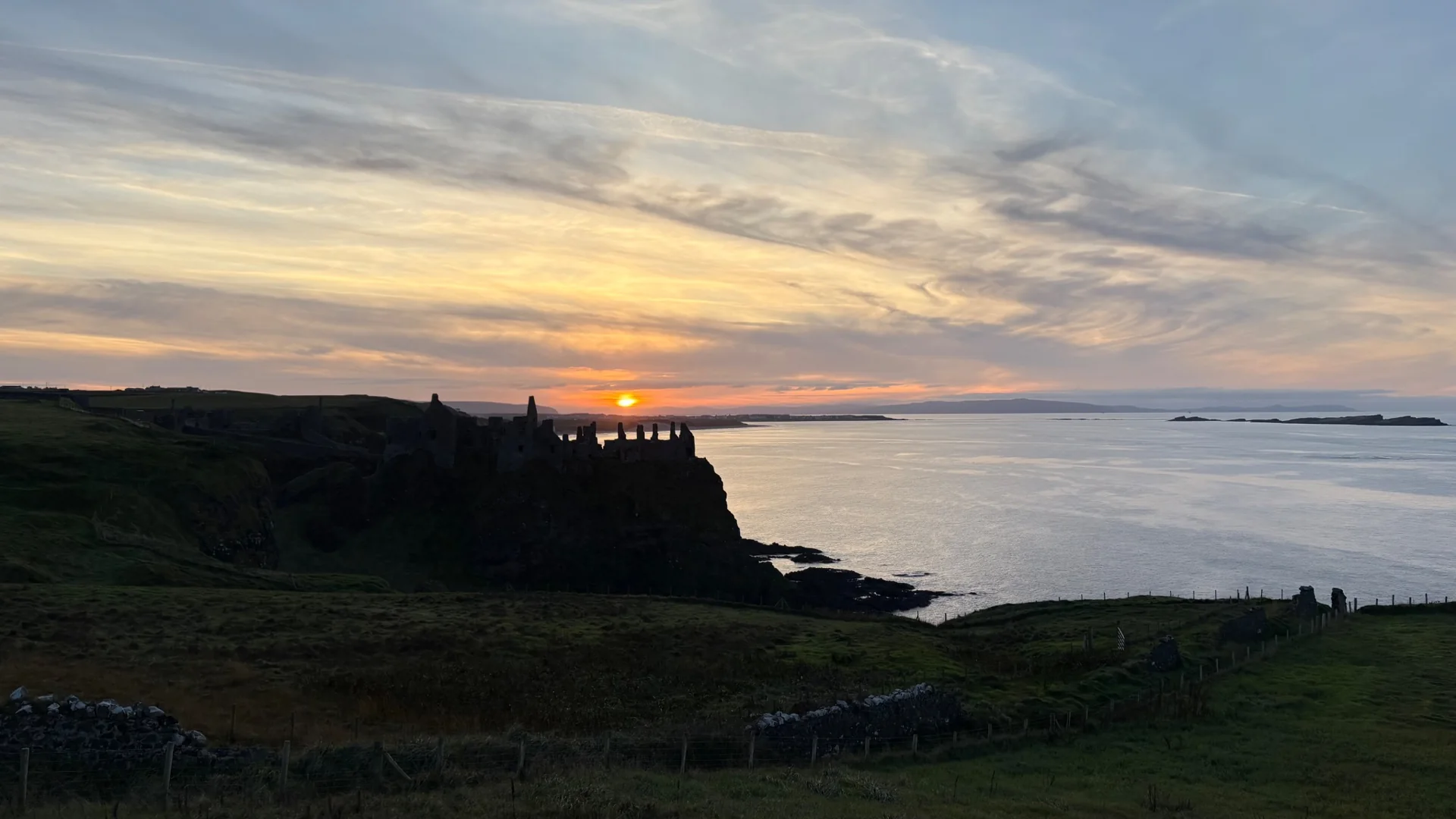
A ruined castle invites questions about power, conflict and ambition. An ancient road suggests journeys undertaken across centuries. A small churchyard may reveal connections between local experience and events of international consequence.
And sometimes the greatest pleasure lies in something less tangible: a conversation, a moment of unexpected recognition, or the discovery that a place has far more to say than its appearance first suggests.
Northbound is my way of bringing those possibilities together.
It draws upon decades of experience in community development, cultural heritage, tourism strategy and personal guiding, but its purpose is refreshingly simple.
To offer guests the opportunity to experience Ireland with the care, insight and individuality that its people and places deserve.
An invitation to look a little closer
The Northbound Journal will be an extension of that philosophy.
It will offer space to explore the histories, landscapes, people and cultural traditions encountered along the way.
Some entries will concern familiar places seen from an unfamiliar perspective. Others will revisit moments in Northern Ireland's cultural and tourism development, or reflect upon people and experiences that have left a lasting impression.
There will be room for literature, architecture, folklore, landscape, personal recollection and the occasional unexpected diversion.
Inevitably, there will be stories within stories.
Because the longer I have spent exploring this island, the more convinced I have become that its greatest richness lies in the connections between seemingly unrelated things.
A place leads to a person. A person leads to a story. And a story changes how we see the place.
That, ultimately, is what Northbound Ireland is about.
Not simply travelling through Ireland, but coming to understand something of it.
And I can think of no better place to begin than with the stories that brought me here.
Fergal Kearney
Founder, Northbound Ireland